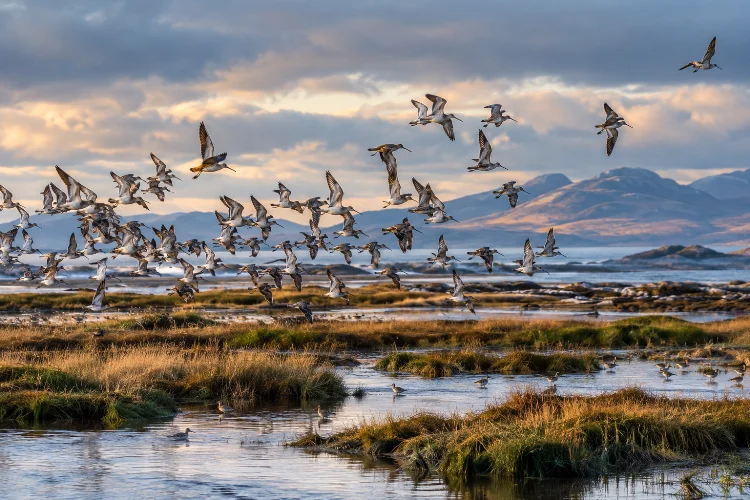
Imagine standing on a peaceful Scottish shoreline as thousands of birds rise above the wetlands, the sea breeze moves through the grass, and the tide slowly reveals an enormous stretch of golden sand.
Pretty amazing, right?
Southwest Scotland offers exactly this kind of experience, and there’s much more to discover than beautiful coastal scenery.
From sheltered estuaries and saltmarshes to rocky cliffs and sandy beaches, the region supports an incredible variety of wildlife. These environments provide essential feeding grounds, nesting areas, and seasonal refuges for birds, marine mammals, and other fascinating creatures.
Exploring wildlife habitats along Southwest Scotland’s coast is a wonderful way to experience nature while discovering some of the country’s quieter destinations.
Unlike Scotland’s busier tourist hotspots, many coastal areas around Dumfries and Galloway offer space for peaceful walking, birdwatching, photography, and outdoor adventures.
Whether you’re planning a weekend escape, a family holiday, or a longer countryside retreat, understanding these natural environments can make your experience even more rewarding.
Let’s discover the habitats, wildlife attractions, and conservation experiences that make this coastline so special.
1. Why Southwest Scotland’s Coast Is a Wildlife Paradise
Scotland is famous for its rugged mountains, dramatic lochs, and breathtaking landscapes.
But its southwestern coastline deserves just as much attention, especially if you’re interested in nature.
A Remarkable Combination of Coastal Ecosystems
Dumfries and Galloway contains an impressive variety of coastal habitats within a relatively accessible region.
The Solway Firth forms a major part of this environment, connecting rivers, estuaries, tidal flats, beaches, and open marine waters.
According to NatureScot, Scotland has approximately 7,076 hectares of saltmarsh habitat, with the largest concentrations found around the Solway Firth.
These marshes aren’t just attractive landscapes. They’re essential ecosystems supporting wildlife and helping coastal environments function naturally.
Mudflats provide feeding areas for shorebirds, while saltmarsh vegetation creates shelter for insects, small animals, and nesting birds.
Rocky shores and offshore waters support another collection of species, including seabirds and marine mammals.
The result is a coastline where wildlife can change dramatically within a relatively short distance.
Understanding the Importance of Tidal Habitats
Tidal habitats are constantly changing.
When the sea retreats, previously submerged mud and sand become exposed, allowing birds to search for worms, molluscs, and other small creatures.
As the tide rises, these feeding grounds gradually disappear beneath the water.
Birds then move towards higher areas where they can rest safely until their next feeding opportunity.
This natural cycle helps explain why coastal wildlife watching can feel different every time you visit.
A quiet mudflat in the morning might become a busy feeding ground later in the day.
And that’s what makes these coastal ecosystems so fascinating to explore.
2. Discovering Saltmarsh Wildlife Around the Solway Firth
Saltmarshes might not immediately sound like exciting tourist attractions.
However, once you understand how much wildlife depends on them, these grassy coastal environments become incredibly interesting.
What Makes Saltmarshes So Important?
Saltmarshes develop in sheltered coastal areas where salt-tolerant vegetation grows on sediment regularly influenced by seawater.
They help trap sediment, provide habitat for wildlife, and can contribute to coastal flood protection.
These environments also store carbon within their plants and soils, making healthy saltmarsh ecosystems valuable in efforts to address climate change.
The Solway Firth contains extensive saltmarsh areas known locally as merse.
These landscapes are particularly important for migratory birds arriving in Scotland during autumn and winter.
Large groups of barnacle geese, for example, travel from Arctic breeding grounds to spend colder months feeding across the Solway’s grasslands and coastal marshes.
Watching these birds move across the landscape can be a surpisingly memorable experience.
Exploring Caerlaverock’s Wetlands
One of the most rewarding places to understand these habitats is WWT Caerlaverock Wetland Centre, near Dumfries.
The reserve combines saltmarshes, freshwater ponds, grassland, and carefully managed wildlife habitats.
Visitors can observe birds from designated hides and viewing areas without needing to walk into sensitive environments.
During autumn and winter, Caerlaverock becomes particularly famous for its visiting barnacle geese and whooper swans.
The Saltcot Merse Observatory provides views across the saltmarsh, where visitors may also spot birds of prey hunting over the coastal landscape.
In warmer months, the reserve offers opportunities to observe wildflowers, insects, breeding birds, and other wetland wildlife.
For beginners, it’s an excellent introduction to coastal ecology because different habitats can be explored from established visitor facilities.
3. Wigtown Bay: An Essential Habitat for Migratory Birds
Further west, Wigtown Bay provides another outstanding example of Scotland’s wildlife-rich coastal environments.
This broad estuarine landscape contains tidal mudflats, saltmarshes, and adjoining wet grassland that support numerous bird species.
Why Wigtown Bay Attracts So Many Birds
The bay’s tidal sediments contain invertebrates that provide an important food source for waders and wildfowl.
Its sheltered setting also creates suitable feeding and resting areas for migrating birds.
Species such as redshanks, curlews, oystercatchers, and different ducks may be encountered around suitable parts of the estuary.
During colder months, geese and swans add another dimension to the landscape.
The combination of large open spaces and nearby hills makes Wigtown Bay particularly attractive for nature photography.
However, the exposed mudflats can be dangerous to walk across because of soft sediment, hidden channels, and changing tides.
Visitors should use established paths and designated viewpoints rather than attempting to approach birds across the estuary.
Visiting RSPB Crook of Baldoon
RSPB Crook of Baldoon is one of the best locations for wildlife observation around Wigtown Bay.
The reserve contains saltmarsh, mudflats, lagoons, and restored wet grassland, creating habitats for a variety of birds.
According to the RSPB, winter visitors include pink-footed geese, barnacle geese, shelducks, and whooper swans.
During spring and summer, the restored grassland can support breeding lapwings and redshanks.
You don’t need specialist equipment to enjoy a visit, although binoculars make distant wildlife much easier to identify.
The reserve has a viewing structure overlooking a lagoon and a short accessible path near the entrance.
For visitors staying around Wigtown, Newton Stewart, or Creetown, Crook of Baldoon can be a rewarding addition to a countryside holiday.
It’s also an excellent place to appreciate how practical habitat restoration can benefit wildlife.
4. Exploring Sandy Beaches, Dunes, and Wetlands at Mersehead
Not every important wildlife habitat looks like a traditional nature reserve.
Sometimes, the most interesting environments are hidden behind seemingly ordinary stretches of sandy coastline.
RSPB Mersehead demonstrates how beaches, dunes, farmland, and freshwater wetlands can support wildlife within one connected landscape.
The Wildlife Living Beyond the Beach
Located along the northern shore of the Solway Firth, Mersehead contains freshwater pools, mudflats, woodland, farmland, and sandy coastal environments.
This mixture of habitats creates opportunities to observe different species throughout the year.
In autumn, migrating barnacle geese begin arriving, while winter brings large gatherings of waterbirds.
Spring introduces breeding activity, with birds establishing territories across the grassland and wetlands.
Lapwings are particularly interesting to watch because of their distinctive flight displays.
Mersehead is also associated with the rare natterjack toad, a species that depends on suitable shallow breeding pools and nearby terrestrial habitat.
These amphibians are protected, so visitors should never attempt to handle them or disturb breeding locations.
Walking Through Different Coastal Environments
Mersehead offers established walking routes that allow visitors to experience several habitats during one outing.
The Wetland Trail is approximately 3 kilometres long, while the Coastal Trail covers around 4 kilometres.
The latter includes softer ground and sections where access can depend on the tides.
Walking through the reserve reveals how different ecosystems connect.
A quiet freshwater pond might contain feeding ducks, while surrounding grassland supports smaller birds and insects.
Further towards the beach, coastal vegetation and exposed tidal sediments create another completely different environment.
If you’re interested in photography, take time to observe the transition between these habitats.
The contrast between open sand, reflective pools, and distant hills can create beautifull landscape compositions.
Just remember that wildlife observations are often better when you’re patient rather than constantly moving.
5. Rocky Cliffs and Marine Wildlife at the Mull of Galloway
While sheltered wetlands dominate parts of the Inner Solway, the outer coastline offers a very different experience.
Here, dramatic sea cliffs, open water, rocky slopes, and coastal grasslands provide habitat for seabirds and marine wildlife.
Discovering Scotland’s Southernmost Point
The Mull of Galloway is mainland Scotland’s southernmost point and one of the region’s most spectacular coastal wildlife destinations.
The area is known for its lighthouse, panoramic sea views, and dramatic cliff formations.
RSPB Mull of Galloway protects a combination of heathland, grassland, and seabird nesting habitats.
During the breeding season, visitors may observe guillemots, razorbills, kittiwakes, shags, and black guillemots around the cliffs.
The nearby Scar Rocks also support a substantial gannet colony.
Watching seabirds navigate strong coastal winds and dive towards the water is an unforgettable experience.
Spring and early summer are particularly interesting because many seabirds return to their nesting areas.
However, breeding activity changes through the season, and sightings depend on weather and other conditions.
Watching Seals and Other Marine Animals
The waters around southwest Scotland can also support marine mammals.
Grey seals and dolphins may sometimes be spotted from viewpoints around the Mull of Galloway, although sightings are never guaranteed.
For the best chance of observing animals naturally, spend time scanning the sea from a safe, elevated location.
Binoculars are useful, particularly when wildlife remains far offshore.
Avoid approaching resting seals or attempting to attract animals closer.
NatureScot’s Scottish Marine Wildlife Watching Code recommends maintaining respectful distances and changing your behaviour when animals show signs of disturbance.
The cliffs themselves also require caution.
Stay on established routes, avoid unstable edges, and supervise children carefully near exposed viewpoints.
6. Choosing the Best Seasons for Coastal Wildlife Watching
One of the great things about wildlife tourism in southwest Scotland is that there’s something interesting to discover throughout the year.
However, different seasons create very different experiences.
Spring: Breeding Birds and Fresh Coastal Life
Spring is an exciting period for wildlife activity.
Birdsong becomes more noticeable, coastal vegetation begins growing, and many species start establishing breeding territories.
At places such as Mersehead and Crook of Baldoon, visitors can observe lapwings, skylarks, and other birds associated with grassland habitats.
Along the outer coast, seabirds begin returning to suitable nesting cliffs.
It’s a rewarding time for nature photography, although visitors must avoid disturbing breeding wildlife.
Summer: Seabirds, Wildflowers, and Longer Days
Summer brings extended daylight and generally more opportunities for outdoor exploration.
Clifftop habitats around the Mull of Galloway can be particularly interesting during the seabird breeding season.
Coastal grasslands and sheltered habitats may also support butterflies, bees, and other insects.
Longer daylight hours allow visitors to enjoy slower walks without feeling pressured to finish early.
However, Scottish coastal weather remains changeable.
Even during summer, waterproof clothing and warmer layers are worth carrying.
Autumn and Winter: Spectacular Migratory Wildlife
For serious birdwatchers, autumn and winter can be some of the most rewarding periods.
Large flocks of barnacle geese return to the Solway, while swans, ducks, and wading birds gather around wetlands and estuaries.
Cold-weather birdwatching can feel especially atmospheric.
Imagine standing inside a wildlife hide while geese fly overhead and distant hills disappear beneath soft winter clouds.
It’s a peaceful experience that’s difficult to recreate in busier tourist destinations.
Winter visits require additional preparation, including warm clothing, suitable footwear, and checking visitor facilities before travelling.
Whatever the season, wildlife sightings are never completely predictable.
That’s part of the fun.
7. Planning a Responsible Wildlife Holiday in Southwest Scotland
Exploring coastal ecosystems doesn’t require an expensive guided expedition or specialist outdoor experience.
With a little planning, visitors can enjoy a comfortable holiday while protecting the environments they’ve come to appreciate.
Creating a Flexible Wildlife Itinerary
For a three- or four-day trip, consider exploring one coastal area each day rather than attempting to visit every reserve at once.
You might begin with WWT Caerlaverock to experience freshwater wetlands and saltmarsh habitats.
Another day could focus on Mersehead, where beach scenery combines with woodland and wetland wildlife.
Further west, Crook of Baldoon provides a contrasting estuarine environment around Wigtown Bay.
The Mull of Galloway is best treated as a separate outing because its location at the southern end of the Rhins peninsula involves additional travelling.
Planning around geographical areas helps reduce unnecessary driving and creates more time for outdoor activities.
It’s also worth allowing space for spontaneous stops at local villages, coastal viewpoints, and cafés.
Bringing the Right Equipment
Comfortable waterproof footwear is one of the most useful things you can bring.
Coastal paths can become muddy, while exposed viewpoints may feel cold even when the weather seems pleasant.
Binoculars are ideal for spotting distant birds and marine mammals.
A camera with a zoom lens is useful for photography without approaching sensitive wildlife too closely.
Bring drinking water, snacks, and a fully charged phone, especially when visiting rural locations with limited facilities.
Check weather forecasts, local access information, and tide predictions before heading out.
Never assume that exposed estuary mud or sand is safe to cross just because the tide appears low.
Respecting Wildlife and Fragile Habitats
Responsible wildlife watching is essential for protecting southwest Scotland’s coastline.
NatureScot encourages visitors to minimise disturbance, remain aware of animal behaviour, and follow local conservation guidance.
Keep dogs under close control, particularly near ground-nesting birds and grazing livestock.
Avoid leaving established paths where access restrictions protect vulnerable habitats.
Don’t collect wildlife specimens, disturb nests, or attempt to handle animals.
If a bird or marine mammal appears unsettled by your presence, increase your distance rather than continuing to approach.
Some habitats can be damaged more easily than they appear.
Saltmarsh soils, nesting areas, and fragile dune vegetation may be affected by repeated trampling or vehicle access.
Even simple actions such as taking litter home and avoiding unnecessary noise can make a difference.
Supporting local conservation organisations is another worthwhile option.
You might choose to participate in organised wildlife walks, contribute to conservation projects, or visit centres that invest in habitat restoration.
These activities can help visitors understand the region’s environmental challenges while supporting practical conservation efforts.
And don’t feel that you must photograph every animal you encounter.
Sometimes, the best wildlife experience is simply watching nature unfold without interfering.
Southwest Scotland’s coastline is much more than a collection of scenic beaches and traditional seaside villages.
Its saltmarshes, estuaries, dunes, freshwater wetlands, and dramatic cliffs create valuable habitats supporting an impressive variety of wildlife.
From wintering geese at Caerlaverock to breeding seabirds at the Mull of Galloway, every coastal environment offers something different.
Exploring these landscapes becomes even more rewarding when you understand how the habitats function and why protecting them matters.
With suitable planning, comfortable equipment, and a respectful approach to wildlife, visitors can enjoy meaningful nature experiences throughout the year.
Ready to experience Scotland’s incredible coastal biodiversity? Start planning your southwest Scotland wildlife adventure, explore its protected nature reserves, and discover the natural beauty waiting beyond the region’s familiar tourist attractions.